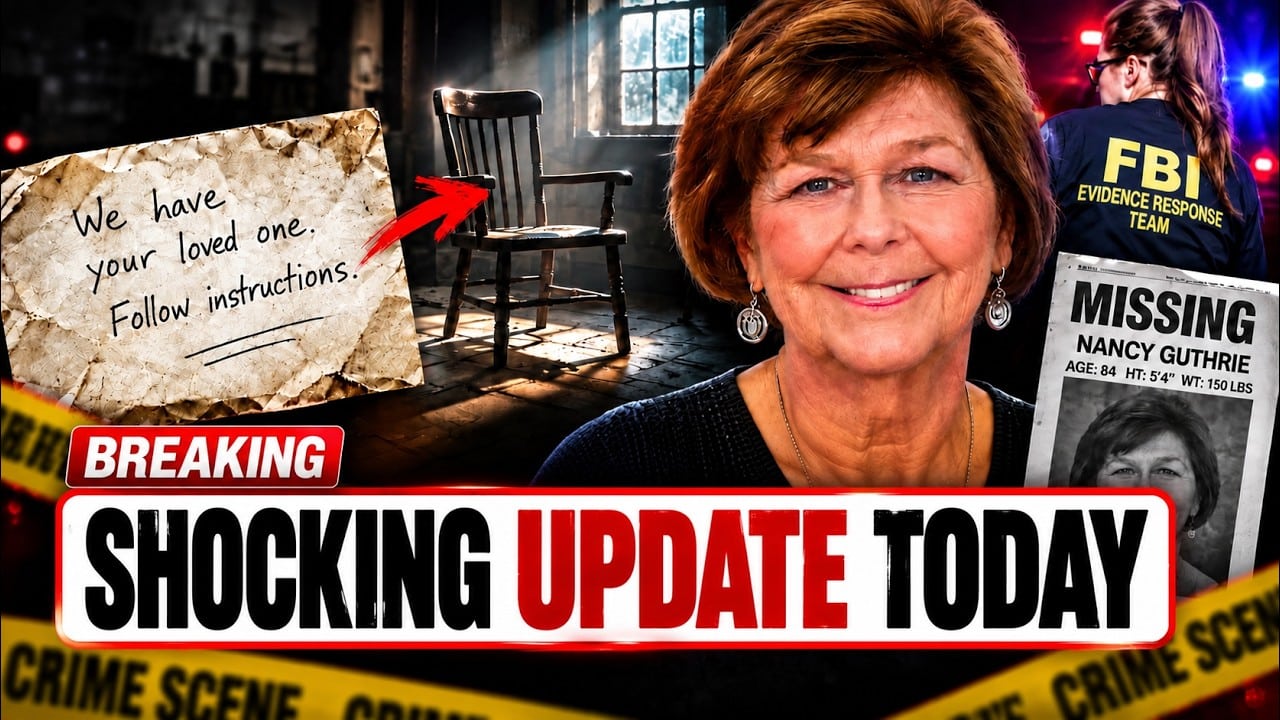
Months after the abduction of 84-year-old Nancy Guthrie from her home in the Catalina Foothills, the case remains one of the most puzzling and frustrating investigations for both the public and law enforcement. As the FBI and Pima County Sheriff’s Department continue their work, a divide has emerged between the official investigation’s caution and the stark physical evidence left at the scene.
The Evidence: What We Know
The case is defined by a series of disturbing, contradictory findings. Forensic evidence discovered at the property includes blood on the front doorstep (0:00–0:02) and doors found propped open at the rear of the home. Investigators are grappling with the fact that Nancy, who required daily medication and had limited mobility, was taken without her phone, shoes, or hearing aids (0:58–1:05).
Perhaps the most chilling aspect is the “porch guy” footage (1:59). Surveillance captured a masked individual approaching the home equipped with gear that retired homicide investigators suggest may have included a tarp (2:07–2:13)—a detail that heavily implies the abduction was not intended to be a long-term, safe hostage situation.
The Ransom Notes and the Official Stance
The investigation took a theatrical turn when ransom notes were sent not to the family, but to television stations (11:01–11:06). These communications eventually included an “apology note” claiming that Nancy had died (0:07–0:12).
Despite this, there is a persistent tension between the evidence and official messaging. While the family, particularly her daughter Savannah Guthrie, has spoken publicly in spiritual terms that suggest they believe Nancy is no longer alive (3:13–3:20), official law enforcement channels have often maintained a more optimistic, albeit vague, public stance, refusing to officially close the case as a homicide until a body is produced (0:46–0:55). Critics and former FBI agents suggest this may be an attempt to manage public perception or institutional reputation, rather than a reflection of the facts on the ground.
Why the Case Stalled
Many experts point to the early response as a critical failure. If the scene was not secured correctly, or if evidence—such as a rubber mat or disturbed foliage—was not processed with sufficient urgency in the first 24 hours, the case effectively became an uphill battle (7:16–7:50).
Furthermore, the “ransom” narrative appears to be a double-edged sword. While it drew massive national media attention, it also allowed the investigation to be framed as a hostage negotiation. However, if the abduction was a “wrench scenario”—a term used to describe using a vulnerable person as leverage to extract value or secrets from a wealthy or high-profile family—then the primary goal of the perpetrators may have been achieved without ever needing to keep Nancy alive (12:06–12:51).
Seeking the Truth Beyond Speculation
In the absence of a named suspect or a recovered body, the vacuum has been filled with internet theories, rumors about local acquaintances, and even unverified accounts regarding events across the border (20:05–20:36). It is crucial for observers to distinguish between these theories and established facts. The case of Nancy Guthrie is not a fictional puzzle; it is an active investigation involving an elderly woman who deserves justice.
As the months pass, the focus remains on the “braid of three tensions”: the physical proof against official silence, the knowledge required for such a specific crime, and the theatrical nature of the ransom communications. Until a significant break—likely in the form of a witness coming forward or a forensic match—the stones outside Nancy’s front door continue to tell the only part of the story that matters: an act of violence that took a woman from her home and left a family in search of answers.