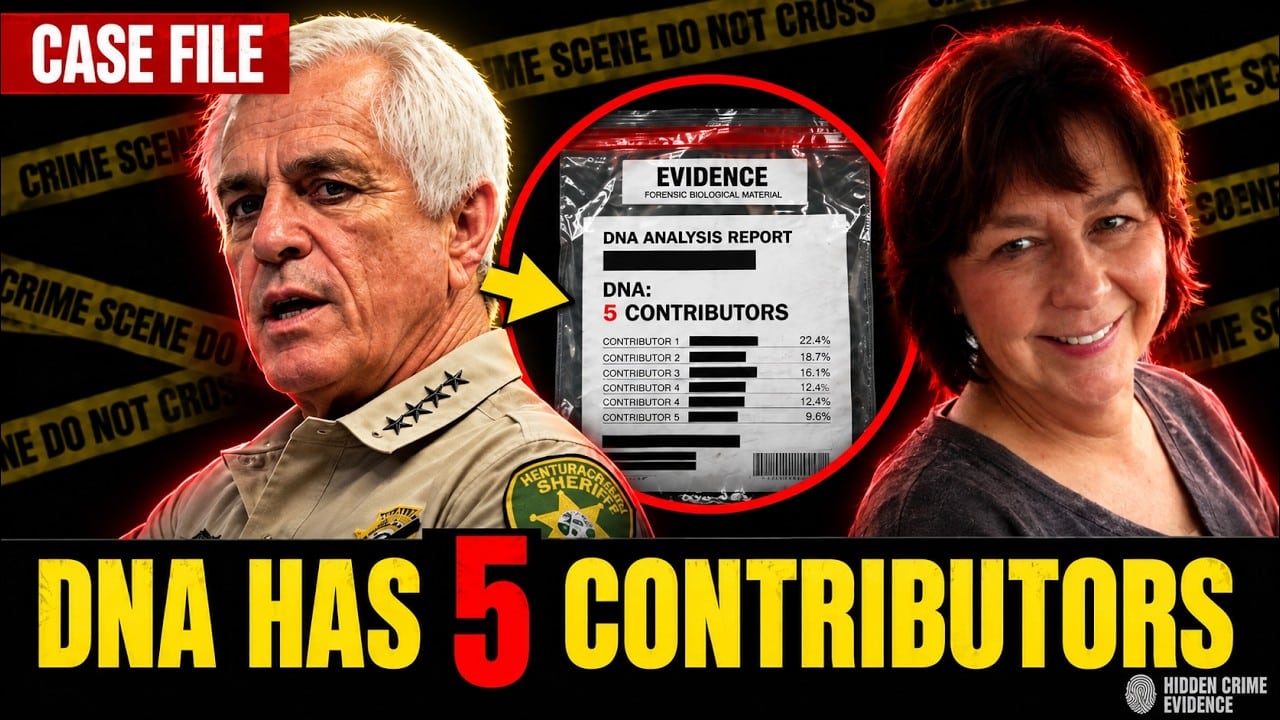
Nancy Guthrie DNA: The Unidentified Contributors Behind a Cuthrie DNA: The Unidentified Contributors Behind a Complex Forensic Mysteryomplex Forensic Mystery
Months after Nancy Guthrie vanished from her Arizona home, one of the investigation’s most challenging questions remains unanswered: Can DNA evidence help identify the person responsible for her disappearance?
Investigators have been examining a complicated mixture of genetic material recovered from Guthrie’s home. The evidence has attracted significant attention because it could potentially provide an important lead. However, forensic experts face a difficult task: separating genetic material from multiple individuals to determine whether any of it can be reliably linked to a suspect.
Despite headlines suggesting that five unidentified people have been discovered through DNA testing, public reporting has described a mixture involving genetic material from as many as four people. Authorities have not publicly identified all contributors or established that every contributor is connected to the crime.
Why the DNA Evidence Is So Complicated
Nancy Guthrie, the 84-year-old mother of “Today” show co-anchor Savannah Guthrie, disappeared from her home in the Catalina Foothills area near Tucson, Arizona, in early February 2026.
Investigators recovered biological evidence from the property and began working with forensic laboratories to determine whether it could help identify the person responsible.
According to reporting by ABC News and CBS News, the DNA mixture has proved difficult to analyze. When biological material from multiple people is combined, scientists must distinguish the different genetic contributions before determining whether a useful profile can be developed.
The challenge becomes even greater when the sample contains only a small quantity of DNA or genetic material that has degraded.
In some cases, modern laboratory techniques can extract useful information from complex samples. In others, the evidence may not provide a sufficiently clear profile for comparison.
That uncertainty has made the Guthrie DNA investigation a painstaking process rather than a straightforward identification exercise.
Does the DNA Point to Five Unknown People?
The number of people potentially represented in a mixed DNA sample is not the same as the number of suspects.
Public reporting has described the main DNA mixture as containing genetic material from as many as four individuals. That does not mean investigators have identified four suspects, nor does it establish that every person whose DNA may be present had anything to do with Guthrie’s disappearance.
DNA can be transferred through ordinary contact, and a person’s genetic material may appear in a location for reasons unrelated to a crime. Investigators must consider where the sample was found, how it may have been deposited, and whether other evidence supports a connection.
Authorities have not publicly announced a confirmed DNA match identifying the person who abducted Guthrie.
The distinction is crucial: an unidentified DNA contributor is not automatically a criminal suspect.
The Hair Sample That Produced No DNA Profile
Another potential lead emerged when investigators examined a hair recovered from Guthrie’s home.
In July, Pima County Sheriff Chris Nanos told reporters that testing had failed to produce a usable DNA result from that hair sample. The result did not identify a suspect.
However, investigators preserved the sample because it might still prove useful if a relevant comparison becomes possible or if other testing methods become available.
The result represents a setback, but it does not mean all DNA evidence in the case has been exhausted. The hair was only one item among the biological evidence investigators have been examining.
Could Genetic Genealogy Provide the Breakthrough?
Investigators have also explored investigative genetic genealogy, a technique that can sometimes help identify an unknown DNA contributor through genetic relationships and family-tree research.
The method has helped solve other criminal investigations, but its usefulness depends on the quality of the DNA profile and whether suitable comparisons can be made.
A complicated mixture may first need extensive analysis before scientists can isolate a profile appropriate for further searching. Even when a possible family connection emerges, investigators must independently verify the lead using additional evidence.
A genetic association alone does not prove that a person committed a crime.
What Happens Next?
Investigators must continue evaluating the DNA alongside surveillance footage, physical evidence, witness information, and the timeline surrounding Guthrie’s disappearance.
The critical question is not simply how many people may have contributed DNA to a sample. It is whether scientists can isolate meaningful genetic information and establish a reliable connection to the person responsible.
For now, the DNA evidence remains an investigative avenue rather than a publicly confirmed solution.
Nancy Guthrie’s family is still waiting for answers. Until authorities announce a verified identification or other decisive finding, the identities of any unknown contributors—and their possible relevance to the case—remain unresolved.