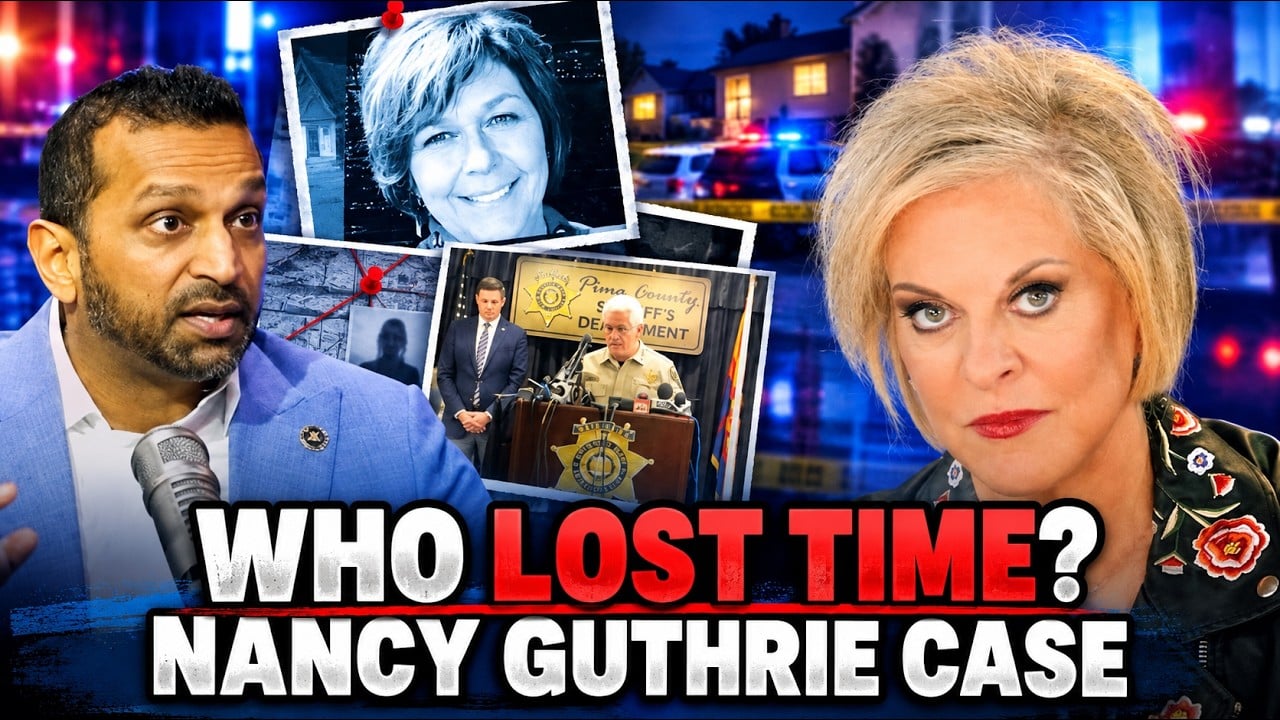
CLASH OF TITANS: NANOS vs. PATEL — Did Investigative Delays Cost Nancy Guthrie Critical Evidence?
A growing dispute between FBI Director Kash Patel and Pima County Sheriff Chris Nanos has intensified scrutiny of the investigation into Nancy Guthrie’s disappearance. At the center of the controversy is a troubling question: Did disagreements over the early response cost investigators valuable evidence that might have helped locate the missing 84-year-old woman?
The disagreement has drawn national attention because time can be critical in a suspected abduction. However, while Patel has publicly criticized the timeline for federal involvement, Nanos disputes the suggestion that the FBI was kept out of the investigation.
What remains unknown is whether any alleged delay actually affected the outcome of the search.
Patel Raises Concerns About Lost Video Evidence
In public comments reported by Fox News in July 2026, Patel said the FBI was kept out of the investigation for approximately four days. He argued that earlier federal involvement might have improved investigators’ chances of recovering additional surveillance footage.
The concern centers on Nancy’s Google Nest doorbell camera. According to Patel, investigators worked with Google to recover cached video data that was not intended for long-term storage. Nancy did not have a cloud subscription that would preserve the footage in the usual way.
The recovered material included images of a masked individual appearing to tamper with the camera outside her home around the time she disappeared.
Patel suggested that additional footage might have been recoverable if federal investigators had been involved earlier. Such material could potentially have shown more of the individual’s movements or other details relevant to the case.
But an important limitation remains: there is no public confirmation that additional footage definitely existed or that its loss prevented investigators from identifying a suspect.
The possibility has nevertheless raised questions about how quickly digital evidence was secured.
Sheriff Nanos Pushes Back
Nanos has challenged Patel’s account, saying coordination with the FBI began immediately and that an FBI task-force member was present during the initial stages of the investigation.
The Pima County Sheriff’s Department has maintained that the agencies worked together and that decisions about evidence processing were made according to operational needs.
The department has also defended the cooperation between the private forensic laboratory handling certain evidence and the FBI laboratory in Quantico, Virginia.
That response directly contradicts the implication that federal investigators were simply excluded from the case for several days.
The dispute therefore involves more than personalities. It raises questions about how agencies coordinate during urgent investigations, who controls evidence, and how disagreements should be resolved without compromising the search for a missing person.
Why the First Days Matter
Nancy Guthrie was last seen on January 31, 2026, at her home near Tucson, Arizona. She was reported missing the following day, and authorities believe she was taken against her will.
Surveillance images released by the FBI showed a masked person outside the residence. The images became a major focus of public appeals for information.
Investigators have also examined DNA evidence, security-camera recordings, and ransom-related communications. Despite those efforts, the case has remained unresolved in the latest reporting reviewed for this article.
Digital recordings can be particularly time-sensitive when data is stored temporarily rather than permanently. Recovering such material may require cooperation among investigators, technology companies, and forensic specialists.
That is why Patel’s criticism has attracted attention. However, determining whether any delay caused evidence to disappear would require a detailed examination of the relevant records and technical circumstances.
Did the Dispute Cost Nancy Her Chance of Being Found?
That is the most emotionally charged question—and one that available evidence cannot yet answer.
Patel has argued that earlier access might have allowed investigators to recover more information. Nanos maintains that coordination began promptly and disputes the account of a four-day exclusion.
Neither position, by itself, establishes what additional evidence existed or whether it would have changed the investigation.
A fair assessment would require a verified timeline of notifications, access to the crime scene, requests for evidence, and attempts to recover the camera data.
Without that information, claims that the dispute cost Nancy her life would go beyond what has been established publicly.
The Search for Answers Continues
The disagreement has placed renewed attention on investigative accountability. The public deserves a clear explanation of how evidence was handled, particularly when officials offer conflicting accounts of a high-profile case.
At the same time, public criticism must not distract investigators from identifying the person shown in the surveillance images and following credible leads.
Nancy’s disappearance remains the central issue. Her family continues to face uncertainty, while investigators must work through forensic findings, digital evidence, and information provided by the public.
Ultimately, the critical question is not which official wins the public dispute. It is whether every credible lead has been pursued and every available piece of evidence has been examined.
Did the early disagreements cost investigators valuable time—or did the agencies act more quickly than the public controversy suggests?
Until a complete, independently verifiable timeline emerges, that question remains open.